
August 3, 2024
Ultra-Thin Copper Foil and the Energy Density Trade-Off
Ultra-thin copper foil can reduce inactive mass in lithium-ion cells, but only when thickness control, strength, elongation, and roll quality support production.
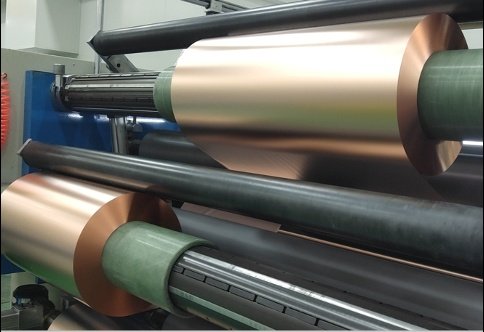
Energy density pressure pushes battery engineers to examine every inactive material in the cell. Cathode and anode chemistry receive the most attention, but current collectors also matter. Copper foil is necessary for anode current collection, yet it does not contribute active lithium storage. Reducing its thickness can help increase the active-material share of the cell.
That is the attraction of ultra-thin battery copper foil. The trade-off is that thinner foil is harder to manufacture, handle, coat, calender, slit, and wind. A thinner current collector only creates value if it can survive the process window and support consistent electrode quality. In other words, the question is not just “How thin can the foil be?” It is “Can the foil run at battery production speed without creating hidden cost?”
The Buyer Problem: More Energy Without More Process Risk
EV cell manufacturers want more energy in the same package because vehicle range, packaging efficiency, and cost per kWh all depend on cell-level energy. ESS manufacturers may put more weight on cycle life and cost per delivered kWh, but material efficiency still matters when production volumes are high.
Current collector thickness is one lever. Moving from a thicker foil to a thinner foil can reduce copper mass and volume. That can create room for active material or support a lighter cell design. However, thin foil is exposed to the same manufacturing stresses as thicker foil: coating tension, dryer heat, calendering pressure, slitting stress, edge handling, winding or stacking, packaging, and transport.
If thin foil wrinkles, tears, stretches unevenly, or creates more scrap, the energy-density benefit becomes less meaningful. A cell plant does not win by qualifying a thin material that disrupts production.
Thickness Control And Areal Weight
Ultra-thin foil requires disciplined thickness control. Nominal gauge matters, but battery manufacturers also need to understand tolerance across width and length. Local thickness variation changes areal weight and can influence electrode loading consistency. In a production environment, small variations can become process tuning problems or quality variation downstream.
Xenith’s product range is positioned around 3.5-12 µm battery copper foil. Its published specification table lists areal weight ranges for 4, 4.5, 5, 6, 7, 8, 9, and 12 µm gauges, with thickness tolerance and width tolerance also specified. For cell engineers, this information is a starting point for checking whether a foil candidate aligns with an electrode design and coating target.
Areal weight is especially important because it connects material choice to cell-level modeling. Battery teams should compare not only nominal thickness, but the practical mass per square meter delivered by each gauge and the variation expected across production rolls.
Mechanical Balance Makes Thin Foil Useful
Thin foil has to be mechanically balanced. Tensile strength helps the foil resist line tension and fracture during processing. Elongation helps it deform without cracking when the web sees bending, handling, winding, or localized stress. Heat resistance matters because drying and thermal exposure can change mechanical behavior.
Xenith publishes standard, medium-strength, high-strength, and ultra-strength tensile categories for selected gauges, including ultra-strength values of ≥600 MPa for 4-6 µm grades in the specification table. The site also states high-strength options above 600 MPa and high elongation above 15% for stable electrode processing. These are relevant proof points because ultra-thin foil cannot be evaluated by thickness alone.
Cell manufacturers should ask how tensile strength and elongation are measured, whether the data applies to the exact gauge under review, and how the foil behaves after thermal exposure. A strong foil with poor ductility can fail in handling. A ductile foil with insufficient strength can deform or wrinkle. The useful product window is the balance.
Surface And Cleanliness Still Matter
Reducing thickness does not remove the need for surface control. The foil still has to accept slurry coating, support adhesion, maintain electrical contact, and avoid defect-driven risk.
Surface roughness affects wetting, coating uniformity, adhesion, and contact resistance. The optimum surface depends on the customer’s anode recipe and coating process. Cleanliness is equally important. Pinholes, nodules, metallic particles, stains, oxidation, scratches, and edge burrs can create electrode defects that are expensive to find late.
Xenith’s published specifications include shiny-side Ra, matte-side Rz, wettability, oxidation resistance, and appearance requirements. The appearance requirements call for a smooth and flat surface, uniform color, no oxidation, spots, corrosion, or oil stains, and neat edges with no burrs or copper dust. These criteria are basic but important because ultra-thin materials leave less margin for defects.
Roll Format Determines Whether Thin Foil Scales
Pilot success is not the same as mass-production readiness. Ultra-thin foil must also arrive in roll formats that fit the customer’s equipment. Width, length, slitting, edge quality, winding profile, and packaging all influence uptime.
Xenith states roll widths up to 1550 mm and lengths from 20,000-30,000 m, with slitting available for customer production requirements. For a cell factory, long rolls can reduce changeovers, while wide formats can fit higher-throughput coating lines. The benefit depends on stable winding, handling, and edge quality, so roll inspection should be included in qualification.
Packaging and storage also deserve attention. Thin foil can be vulnerable to handling damage and surface change if packaging is weak or storage conditions are poor. The product specification identifies sealed plastic film, wooden box packaging, batch marking, and storage at room temperature with relative humidity ≤75%. These details help quality teams manage incoming material condition.
How Cell Teams Should Evaluate The Trade-Off
A disciplined evaluation of ultra-thin copper foil should connect five questions.
First, what cell-level gain is expected from reduced current collector mass? Second, what electrode process changes are needed to run the thinner foil? Third, can the foil maintain strength, elongation, flatness, and edge quality under production conditions? Fourth, does the surface support the customer’s coating and adhesion needs? Fifth, does the supplier provide enough consistency and documentation to support scale-up?
The decision should not be based on gauge alone. A 4 µm or 5 µm foil that causes repeated web breaks may be less valuable than a slightly thicker option that runs cleanly. Conversely, a well-controlled ultra-thin foil can be a practical route to lower inactive mass and better cell design freedom.
The Practical Message
Ultra-thin copper foil is valuable because it can help make every micron count. But thinness is not the full product. Battery-ready ultra-thin foil combines gauge control, areal weight consistency, tensile strength, elongation, thermal stability, surface control, cleanliness, and roll quality.
For cell manufacturers, the best supplier discussion starts with the intended cell platform and production process. The foil should then be qualified against the real manufacturing window. When the material can reduce inactive mass and still run cleanly, ultra-thin copper foil becomes a meaningful energy-density lever rather than a specification risk.
Ready to evaluate BCF for your battery line?
Review Xenith’s copper foil specifications or share your target thickness, roll format, application, and sample requirements with our team.