
August 27, 2024
How Battery Cell Manufacturers Should Qualify Copper Foil Suppliers
A practical qualification framework for lithium-ion cell teams evaluating battery copper foil suppliers, samples, data packages, and production readiness.
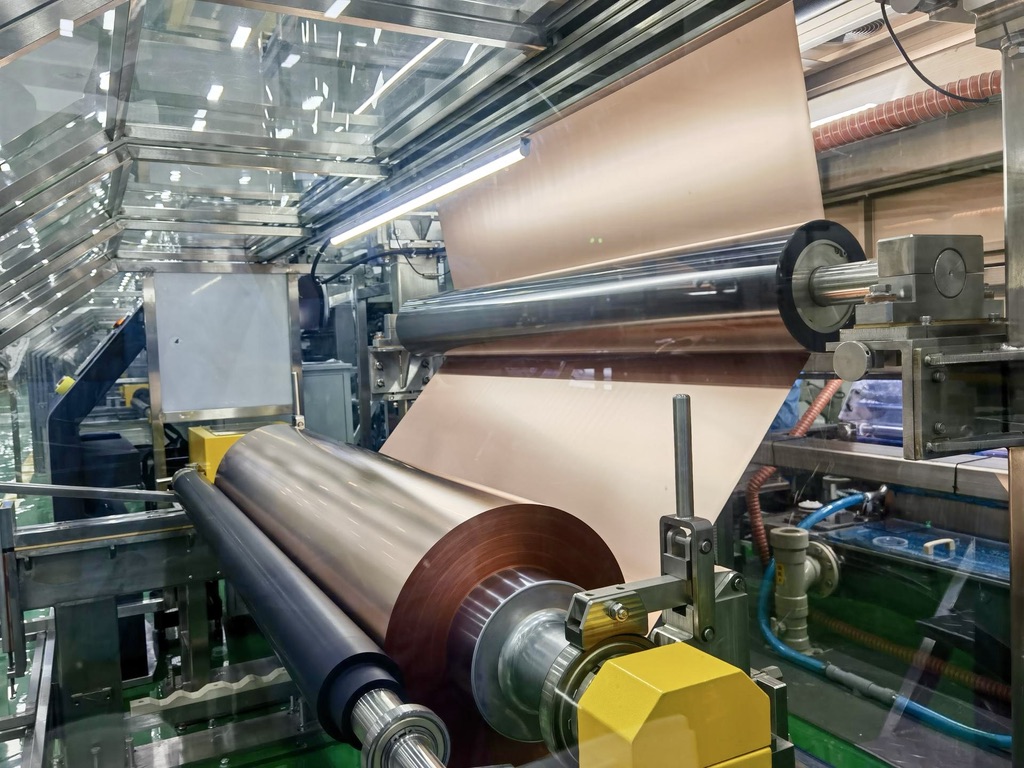
For lithium-ion cell manufacturers, qualifying a battery copper foil supplier is not a purchasing formality. Copper foil becomes the anode current collector, so its thickness, surface condition, mechanical behavior, cleanliness, roll format, and lot consistency can affect electrode yield and cell reliability long after incoming inspection is complete.
A useful supplier qualification process starts with a simple question: will this foil run in the real production window, not only pass a static data sheet? Lab samples can show whether a material is promising, but production readiness is proven through repeatable roll quality, controlled process change, and technical support that matches the pace of cell development.
Start With The Cell Program Requirement
The right foil depends on the cell platform. A high-energy EV cell, a long-life ESS cell, a high-power cylindrical cell, and a pilot silicon-graphite program can all ask different things from the current collector.
Before comparing suppliers, cell teams should define the target foil gauge, anode chemistry, coating method, roll width, roll length, expected line tension, drying and calendering conditions, slit width, winding or stacking process, and qualification timeline. Procurement may compare price per kilogram or price per square meter, but process engineering needs to know whether the foil reduces or creates scrap. Quality teams need to know whether the supplier can hold the same critical properties from sample to mass production.
This is where a battery copper foil supplier should show application understanding. A serious discussion should cover coating behavior, wrinkling, web breaks, edge defects, adhesion, burr control, storage, packaging, traceability, and inspection methods. If the conversation stays only at nominal thickness and price, the qualification risk is still mostly hidden.
Review The Technical Data Package
A complete data package should make the critical-to-quality properties easy to inspect. At minimum, a cell manufacturer should ask for thickness and areal weight by gauge, thickness tolerance, tensile strength, elongation, surface roughness by side, wettability, oxidation resistance, appearance criteria, chemical composition, width tolerance, packaging, and storage guidance.
Xenith publishes its battery copper foil range as 3.5-12 µm, with a product specification table covering 4, 4.5, 5, 6, 7, 8, 9, and 12 µm gauges. The table includes areal weight, tensile categories, elongation, shiny-side Ra, matte-side Rz, gloss, thickness tolerance, wettability, oxidation resistance, appearance, chemical composition, packaging, and storage conditions. These details help engineers compare a proposed foil against the process window they actually need to run.
Mechanical data should not be read in isolation. High tensile strength helps thin foil survive coating tension, calendering stress, slitting, and winding. Elongation matters because a strong but brittle foil can still crack, tear, or create handling defects. Surface roughness should also be treated as an application variable. The best surface is not simply the roughest or the smoothest; it is the surface that supports slurry wetting, coating uniformity, adhesion, and low contact resistance for the customer process.
Test Samples Against Real Electrode Steps
Qualification should move from document review to controlled trials as quickly as practical. A small sample can support material screening, but the most meaningful evidence comes from coating, drying, calendering, slitting, winding, and stacking behavior under representative conditions.
Process engineers should track wrinkles, folds, tears, web breaks, coating streaks, edge cracks, burrs, telescoping, roll handling issues, and any change in electrode loading uniformity. If the foil is thinner than the current production material, the team should pay close attention to line tension, drying stability, and calendering deformation. Ultra-thin foil helps reduce inactive mass only when it can run without turning the electrode line into a scrap generator.
Cell makers should also compare adhesion and interface behavior after calendering, electrolyte exposure, and cycling conditions relevant to the program. The copper foil supplier does not control every part of the electrode system, but it should understand how foil surface morphology, cleanliness, oxidation control, and roll consistency influence the anode interface.
Evaluate Inspection And Traceability
Incoming inspection is only one part of quality control. Battery copper foil qualification should examine how the supplier controls the process before the roll reaches the customer. The evaluation should include inspection equipment, sampling plans, batch records, roll labeling, packaging, corrective action discipline, and change-control practice.
Xenith presents in-house inspection capability that includes tensile testing, constant temperature oven testing, surface roughness measurement, electronic balance checks, scanning electron microscopy, spectrophotometer use, direct-reading spectrometer support, and Leica microscope inspection. The company also presents SGS certification support and quality documentation on the site.
Traceability should connect each roll to the relevant batch and product specification. Packaging also matters. Xenith’s published product specification states that each roll is sealed with plastic film and packed in a wooden box marked with product name, specifications, batch number, net weight, gross weight, ROHS label, and manufacturer. That kind of roll-level information supports incoming control and later root-cause review.
Check Production And Commercial Fit
A technically attractive foil still needs to fit the production line. Roll dimensions, splice policy, slitting capability, width tolerance, storage guidance, and sample-to-volume consistency should be reviewed before final approval.
Xenith states product capabilities including widths up to 1550 mm and roll lengths from 20,000-30,000 m, with slitting available to match customer production requirements. For high-volume cell manufacturing, these details affect changeovers, handling, line utilization, and inventory planning.
Commercial qualification should not reduce the supplier decision to the lowest purchase price. A foil that causes coating defects, breaks, wrinkles, or repeated process tuning can become expensive through scrap and downtime. A stronger evaluation compares cost per good electrode, cost per qualified cell, and the risk of variation over the life of the program.
What A Good Supplier Conversation Sounds Like
The strongest suppliers ask cell-manufacturing questions before recommending a grade: target gauge, anode recipe, binder system, coating speed, drying profile, calendering pressure, roll width, slit width, winding or stacking format, defect history, and qualification schedule.
They also make limits clear. If a claim needs peel strength data, line trial data, defect-density records, or customer-specific testing, it should be treated as a proof item rather than vague marketing language. Xenith’s strongest public proof points are ultra-thin BCF capability, high-strength and high-elongation options, custom roll formats, published specifications, inspection equipment, experienced copper foil leadership, and documentation support.
Qualification Is Risk Reduction
Battery copper foil qualification is a risk-reduction process. It protects cell performance, electrode yield, production uptime, procurement continuity, and quality documentation. The best result is not simply an approved supplier. It is a supplier-material combination that the cell maker can trust as the platform scales.
For battery teams evaluating a new foil source, the practical path is clear: define the cell and process requirement, review the data package, run representative electrode trials, audit inspection and traceability, confirm roll-format fit, and keep every major claim tied to evidence. That is how copper foil moves from sample roll to production material.
Ready to evaluate BCF for your battery line?
Review Xenith’s copper foil specifications or share your target thickness, roll format, application, and sample requirements with our team.